Ajanta Paintings: Two Days with Nāṭya, Śilpa and Citra (ASC174)
–About Ajanta Paintings: Two Days with Nāṭya, Śilpa and Citra (ASC174)
A unique opportunity to immerse yourself in the art of classical Indian painting.
What will you learn on this course?
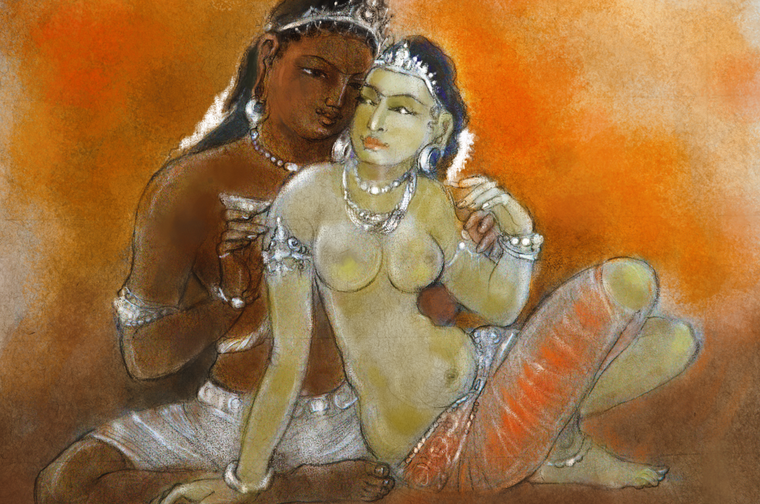
The figures of Ajanta are not posed; they are performing. Each is a moment of drama arrested on the wall: a bhāva held in the face, a rasa carried by the whole composition, a stance and gesture taken from the language of dance, and ornament worn as an actor wears it.
That language comes from the Nātyaśāstra, the foundational text on drama. Its proportions are those of the Śilpaśāstra, the science of measure. Its three-dimensional presence on a flat surface is the technique of the Citrasūtra of the Visnudharmottara Purāna, the oldest surviving text on Indian painting. These are not three systems but one grammar: founded in drama, fixed by measure, realised in paint.
Led by Dr Sindhu Saraswathy, an artist from the Viśvakarmā tradition, these two days teach that grammar through the hand. Day One works through the ornamental world of Ajanta (the lotus and hamsa, the playful yaksas, the elephant, bull and peacock), each form carrying its rasa. Day Two brings the whole grammar to the human figure: stance, proportion, the tribhanga pose, colour and depth.
The programme begins not with technique but with the understanding beneath it. Before the first brushstroke comes Dhyāna, the preparation of the inner eye, and Vrata, the vow that precedes making. Art in this tradition is Sādhanā: a sustained discipline through which correct form becomes available to the hand.
View the full program.
Participants will leave with:
• Ornamental studies of the lotus and haṃsa, the yakṣas, and the elephant, bull and peacock.
• A completed figure study read as Nāṭyaśāstra drama, built on Śilpaśāstra measure, and painted with Citrasūtra technique.
• A working knowledge of bhāva, rasa, sthāna, bhaṅga and āhārya as they appear in painted figures.
• Rekhā, varṇa, vartanā and nimnonnata as studio tools for colour and depth on a flat surface.
• Direct experience of Dhyāna and Vrata as the contemplative ground of making
Dr Sindhu Saraswathy is an artist from the Viśvakarmā tradition — the hereditary lineage of temple builders and mūrti makers whose knowledge of sacred proportion and the grammar of divine form has been carried across generations. She has conducted workshops and lectures in collaboration with the Nehru Centre, the High Commission of India, and The Bhavan. She is the founder of Re-search Hindu, a platform dedicated to reviving the contemplative visual traditions of classical Indian art, and the author of four books including 'The Third Dimension at Ajanta': Breathing Space into Flatness — the first study to systematically correlate the technical principles of the Citrasūtra with specific painted passages in the Ajanta caves.
Who is this course for?
This course is suitable for adults aged 18+. It is open to beginners and improvers, no prior knowledge of Indian art required.
At the heart of MAC is a focus on accessibility and inclusion. Please contact us to discuss your specific access needs. The room is wheelchair accessible. A support worker or carer may assist; carers must book a complimentary ticket if attending to provide support.
Do you need to bring anything?
All materials and equipment are provided. You may wish to bring your own sketchbook or notebook to support your learning.
Are there any additional costs?
There are no additional costs.
Who teaches this course?
Dr Sindhu Saraswathy